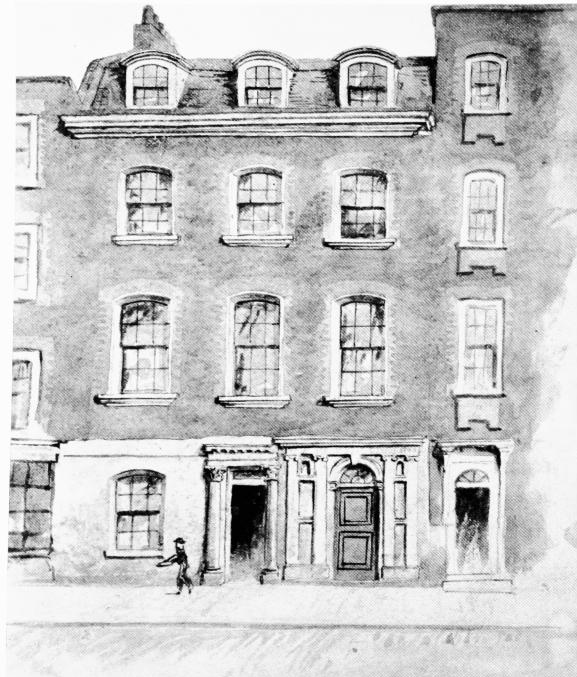
A journey through Regency London in the steps of Sake Dean Mahomet as told in The Hindostanee Coffee House.
Showing posts with label Places. Show all posts
Monday, 18 June 2012
Map of London 1818
Sunday, 10 June 2012
Mr Thomas Lord
Thomas Lord was born in Thirsk, Yorkshire on 23rd November 1755 in what is now the town museum, but the family later moved to Diss in Norfolk where Thomas was brought up. As a young man, Lord moved to London and got a job as a bowler and general attendant at the White Conduit Club in Islington. In 1786 Lord was approached by the Earl of Winchilsea, and the Duke of Richmond, who were the leading members of the White Conduit Club. They wanted him to find a more private venue for their club and made a guarantee against any losses he might suffer. In May 1787 Lord acquired seven acres off Dorset Square in Mary-le-Bone and started his first ground. White Conduit relocated there and soon afterwards formed, or merged into, the new Marylebone Cricket Club (MCC).
The lease on thist ground ended in 1810. Lord's second venue, the subject of our book, was built by 1809. However this land was acquired for the Regent's Canal, which was to cut through the site and thereby necessitating a further move. Lord then moved his ground to the present site in St John's Wood, literally taking his turf with him. It opened in 1814. Lord was not, however, making enough money and therefore obtained permission to develop part of the ground for housing. To counter his plan, Lord was bought out for £5,000 by prominent MCC member William Ward, a noted batsman who was also a director of the Bank of England. Despite the change of ownership, the ground has continued to bear Lord's name.
Lord remained in St John's Wood till 1830 when he retired to West Meon in Hampshire, where he died in 1832. He is buried in the churchyard of St John's Church at West Meon. The village has a public house named after him and is just a few miles from Hambledon, home of the famous Hambledon Cricket Club.
Thursday, 7 June 2012
Royal Hospital Chelsea
The Royal Hospital was founded by King Charles II, to succour and relief of veterans broken by age and war. Sir Christopher Wren was commissioned to design and erect the building, which was based on the Hôpital des Invalides in Paris. The Hospital’s chapel was also designed by Wren and is a fine and rare example of his pure ecclesiastical work. It was designed to accommodate about 500 people.
As a retirement and nursing home for British soldiers who are unfit for further duty due to injury or old age, it is a true hospital in the original sense of the word - that is a place where hospitality is provided. There are over 300 soldiers resident in the Royal Hospital, referred to as "in-pensioners", and when out and about can be seen in their traditional scarlet coats and tricorne hats.
Chelsea Physic Garden
In 1673 the Society of Apothecaries of London founded a physick garden at Chelsea so that their apprentices could learn to grow medicinal plants and study their uses. At the time Chelsea was already famed for its market gardens, and while the garden struggled in the early years, by 1685 the diarist John Evelyn described the heated glass-house, which it thought to be the first in Europe. In 1712 Dr Hans Sloane bought the Manor of Chelsea, along with the freehold of the garden. He had studied in the garden in his youth and was sympathetic to the Apothecaries, to whom he granted a lease on the land for a rent of £5 a year in perpetuity, on condition it be for ever kept and maintained as a physick garden.
In 1983 the garden became an independent charity, and is now open to the public (see www.chelseaphysicgarden.co.uk)
(Nearest tube Sloane Square.)
The Marshalsea Prison
Most of the Marshalsea Prison, off Borough High Street in Southwark on the south bank of the Thames, was taken up with debtors. In 1799 a government report stated that the prison had fallen into decay, and proposed its re-building, which was completed in 1811. The second Marshalsea had two parts, one set aside for Admiralty prisoners under court martial, and the other for debtors. In 1827, 414 out of its 630 debtors were there for debts under £20. Charles Dickens' father, John, was sent there as a debtor on 20th February 1824, under the Insolvent Debtor's Act 1813; he owed a baker £40 and 10 shillings, a sum equivalent to £2,939 in 2012. He was released after three months.
The prison was notoriously cramped. A report in 1833 said there were "an average of more than four persons in each room which are not ten feet square! I will leave the reader to imagine what the situation of men, thus confined, particularly in the summer months, must be." The Marshalsea was closed by an Act of Parliament in 1842, and the inmates were relocated to either another prison or the Bethlem hospital if they were mentally ill.
All that remains of the Marshalsea today is the brick wall that marked the southern boundary of the prison, now called Angel Place. It is just north of the junction of Borough High Street and Tabard Street.
(Nearest tube stations Borough High Street and London Bridge.)
Tuesday, 22 May 2012
Almack's Club
Unlike all other London clubs, Almack's, on King Street in St. James, was governed by a select committee of the most influential and exclusive ladies in London society. These fair arbiters imposed an aura of exclusivity on the balls held on Wednesday nights. They allowed only those whom they approved to buy the non-transferrable annual vouchers, which cost ten guineas, and to lose one's voucher meant that one had been tried and found wanting, in short a social disaster. Refreshments in the supper rooms consisted of thinly-sliced bread with fresh butter, and a dry cake similar to pound cake. To avoid drunkenness, only tea and lemonade were served in the supper rooms. Besides the dancing and supper rooms, Almack's also provided gaming rooms for those who preferred cards to dancing.
(Nearest tube Green Park).
Monday, 21 May 2012
White Lodge, Richmond, Surrey
Nearest tube Richmond or Kew Gardens and a very, very long walk!
The Second Theatre Royal, Covent Garden
Rebuilding began in December 1808, and the second Theatre Royal, Covent Garden (designed by Robert Smirke) opened on 18 September 1809 with a performance of Macbeth, with Sarah Siddons as the Lady. The actor-manager John Philip Kemble had raised seat prices to help recoup the cost of rebuilding, but the move was so unpopular that audiences disrupted performances by beating sticks, hissing, booing and dancing. The Old Price Riots lasted over two months, and the management was finally forced to accede to the audience's demands.
The nearest tube is Covent Gadren, of course.
Tyburn Turnpike and Oxford Street
The Tyburn Turnpike, at the junction of the Oxford Road (now Bayswater Road) and Oxford Street, was described at the time as: the grandest passage into our immense metropolis. Oxford-street, from its uniform breadth, its commodious and spacious foot-way, and great extent, being one mile and a quarter, is allowed to be one of the finest streets in Europe. Oxford Street follows the route of a Roman road, the via Trinobantina, and became one of the major routes in and out of the city. In the late 18th century many of the surrounding fields were purchased by the Earl of Oxford, and the area was developed, with many shops appearing from the Regency period onwards.
A turnpike is a gate set across the road to stop carts until a toll was paid, and the money collected was used to maintain the highway. The Tyburn Turnpike was near to where the "Tyburn Tree" was erected. This was the gallows on which, until 1783, public hangings took place in London. A plaque commemorating the gallows lays near to Marble Arch.
Nearest tube Marble Arch.
Ayre's Brewery & Hickford's Room
Around 1664 Thomas Ayres, a brewer, built a brewery on the north side of Little Pulteney Street (now part of Brewer Street) . By 1700, when the brewery had stood unused for several years, an expenditure of at least £1000 was required to put the building back into repair, and the Ayres found two brewing partners, Robert Billings and John Lanyon, to purchase the brewery. A nineteenth-century plan of the site shows an irregularly shaped yard approached half-way along by a narrow entrance on the east side of Little Windmill Street with a main entrance in Little Pulteney Street. A dwelling-house stood in the yard near the main entrance and the brewery buildings were ranged on either side of the yard. The brewery continued in use until 1826, when the then owners were declared bankrupt.
In 1718 Nicholas Dubois of St. Martin's in the Fields let a plot of ground on the south side of Brewer Street. Dubois was an architect of French birth who had lived in England for some years and built himself a house on the site. By 1738 it was tennanted by John Hickford, whose family had managed a dancing school in Panton Street since 1696. There is no direct evidence whether John Hickford built the concert room to the rear of Dubois' house which until 1934 stood behind No. 41 Brewer Street, or whether he moved there because the room was already in existence. Hickford's Room enjoyed its greatest fame in the 1740s and 50s, when it was the only concert room of note in the West End of London. The winter series of subscription concerts were a recognized part of the fashionable London season, and works by Handel, Arne and Boyce were frequently performed there, sometimes, perhaps, in the composer's presence. Most famously was the notice of 11 March 1765 in the Public Advertiser which read:
For the Benefit of Miss MOZART of Thirteen, and Master MOZART of Eight [sic] Years of Age, Prodigies of Nature. HICKFORD'S Great Room in Brewer Street, Monday, May 13 will be A CONCERT of MUSIC With all the OVERTURES of this little Boy's own Composition
The decline of Hickford's Room began shortly after this with the opening of more and more competition. Between 1791 and 1814 there was a series of short tenancies; and the building was sometimes empty. In 1793 there was a fencing match, in 1794–5 a series of charity concerts for the 'Society of French Emigrants', and in 1797 lectures by 'one Jones and others of public notoriety' against religion and morality.
Nearest tube Piccadilly.
Thomas Lord's Second Ground
Nearest tube Baker Street or Marylebone.
St Mary-le-Bone church
The third church in Mary-le-Bone was built in 1740 and replaced another small church on the same site. Charles Wesley, composer of Hark the Herald Angels Sing among other great hymns, was the Rector of St Mary-le-Bone. He died on 29 March 1788 and his body laid to rest St Mary-le-Bone Church graveyard. A memorial stone to him stands in the gardens in the High Street in modern Marylebone, close to where he was buried. Lord Byron was baptised there in 1788. and Admiral Lord Nelson worshipped there and his daughter Horatia was baptised in that church. The Chapel in Portman Square (long gone) was attached to St Mary-le-Bone. The church was replaced by the current one at the tip of the High Street in the 1820s.
Nearest tube Baker Street or Marble Arch. |
Hunterian Medical School
Set up by the eminent physician William Hunter in Soho's Great Windmill Street in the 1760s, the school which Decimus Doyle attends was one of several in London educating gentlemen in the medical arts. Medical practices were often barbaric, using similar methods that had been common for centuries, which yielded little other than killing the patient with a different affliction than the original ailment. Leeching (or blood letting), purgation and cold water dousing were common. There were three medical institutions: the Royal College of Physicians, the Royal College of Surgeons, and the Society of Apothecaries. Physicians were university-educated and considered the most knowledgeable about medicine. They were not permitted to act as surgeons or dispense drugs as apothecaries. They were only permitted to examine patients, diagnose disease, and prescribe medications, and in 1800 there were 179 licensed physicians, though there were many more unlicensed ones. Decimus Doyle, therefore, was entering a rarified world. Surgeons performed operations, set broken bones, and treated accident cases and skin disorders. Apothecaries were not only druggists responsible for the sale, compounding, and supply of drugs but, thanks to the Apothecaries Act of 1815, were able to provide medical advice and prescribe medication themselves.
Nearest tube Piccadilly.
Thursday, 17 May 2012
Portman Square
The Honourable Basil Cochrane's mansion in Portman Square was described as being among the largest in the square, at the south west corner, and also accommodated the ambassador of the Ottoman Sultan (Turkey). Cochrane also set up his Indian vapour baths to the side of the property.
Nearest tube Marble Arch.
Tuesday, 15 May 2012
The Hindostanee Coffee House
From The Times:
HINDOSTANEE COFFEE-HOUSE, No. 34 George-street, Portman square - MAHOMED, East-Indian, informs the Nobility and Gentry, he has fitted up the above house, neatly and elegantly, for the entertainment of Indian gentlemen, where they may enjoy the Hoakha, with real Chilm tobacco, and India dishes, in the highest perfection, and allowed by the greated epicures to be unequalled to any curries ever made in England with choice wines, and every accommodation, and now looks up to them for their future patronage and support, and gratefully acknowledges himself indebted for their former favours, and trusts it will merit the highest satisfaction when made known to the public.
Spelling is subjective, though the plaque makers might have referred to the coffee house name as in Mahomet's original advertisement (above). That said, I have retained the first version of his name as published in the 1780s book (the T for a D) throughout. 34 George Street became 92 in 1872 and was completely re-built in 1957. The green plaque resides at 102 for practical reasons! The picture below was taken in the 1950s before the terrace was re-built. The Hindostanee Coffee House was in the property to the far right, on the corner.
Nearest tube Marble Arch.
HINDOSTANEE COFFEE-HOUSE, No. 34 George-street, Portman square - MAHOMED, East-Indian, informs the Nobility and Gentry, he has fitted up the above house, neatly and elegantly, for the entertainment of Indian gentlemen, where they may enjoy the Hoakha, with real Chilm tobacco, and India dishes, in the highest perfection, and allowed by the greated epicures to be unequalled to any curries ever made in England with choice wines, and every accommodation, and now looks up to them for their future patronage and support, and gratefully acknowledges himself indebted for their former favours, and trusts it will merit the highest satisfaction when made known to the public.
Spelling is subjective, though the plaque makers might have referred to the coffee house name as in Mahomet's original advertisement (above). That said, I have retained the first version of his name as published in the 1780s book (the T for a D) throughout. 34 George Street became 92 in 1872 and was completely re-built in 1957. The green plaque resides at 102 for practical reasons! The picture below was taken in the 1950s before the terrace was re-built. The Hindostanee Coffee House was in the property to the far right, on the corner.
Nearest tube Marble Arch.
Subscribe to:
Posts (Atom)


